Tucker was built in 1962. It has never been renovated and is slated for a complete, $55 million renovation.
HENRICO COUNTY, Va. -– The 56-year-old J.R. Tucker High School has been thrust into the spotlight as Henrico County officials start to dialogue that replacing some older schools, instead of renovating them, may be a better option for the county.
Recently, Assistant Superintendent Al Ciarochi presented to the Henrico School Board a proposal for a $10,000 feasibility study that will scrutinize the possibility of temporarily relocating J.R. Tucker students six miles away to the former Best corporate offices on Parham Road, near Interstate 95. The move would occur if Tucker were to be replaced instead of renovated, the latter of which $55 million is already funded by the county’s 2016 bond referendum. The cost of a new school is estimated to be around $80 million.
County Manager John Vithoulkas called the mammoth, 93-acre parcel bought by the county for $6.2 million in December 2011 one of Henrico’s most valuable available properties; it was valued at $26 million in 2009.
The feasibility study is simply just the first step in a much longer process of ideally replacing some schools, something which several board members and county officials called innovative. The 2016 bond referendum allocates $272.6 million to renovate eight schools and build or expand four new schools.
“Part of this has stemmed from the cost of school renovations in comparison to school replacements, as well as how a replacement may impact economic development and community revitalization,†Ciarochi said.
“Which I think this is a drastic shift in policy, that we might head this way,†said Three Chopt representative Michelle Ogburn, who expressed hope that the county would move away from its 16 campus style schools.
Supervisor Patricia S. O’Bannon of the Tuckahoe District, originally presented the idea to replace Tucker. O’Bannon said her initial concern was student safety, and that she has always considered the campus-style school, sandwiched between Broad and Parham, to be in a “vulnerable location.â€
But additionally, she said, are the needs for space, and innovation. Replacing the campus-style school at landlocked Tucker would provide more field and parking space.
J.R. Tucker, built in 1962, is landlocked in its spot at 2900 N. Parham Road.
O’Bannon credited former interim superintendent Harvey Hinson for helping “us think more forward.†She recounted that Hinson said maybe the county should think more like business, who “usually, after 60 years tear down a structure, because you can’t renovate something but so many times before it needs to be torn down.â€
Forty-one of Henrico’s 72 schools are at least 50 years old, according to the county.
“Campus-style schools were a popular style of construction in a different generation,†Andy Jenks, Henrico County Schools spokesman. “If someone is looking to build a new school in Virginia, I don’t think you would see them choose that as a design.â€
“Safety would be one reason, efficiency would be another,†he added.
“WHY NOW, WHY TUCKER?” ASKS SCHOOL BOARD REPRESENTATIVE
Tucker High, built in 1962, according to officials, has never been renovated. The school is slated for a full scale renovation, which includes everything except the athletic fields.
The board approved the study, though Varina district representative John Montgomery opposed, and questioned why the Best building was currently available, but was not during the multi-million dollar renovation of Henrico High School, in 2013.
“Is there something about the area around Tucker that is more susceptible and more inviting for economic development and revitalization, than say the community are Henrico High,†Montgomery asked. “What about Henrico High School community is not deserving?â€
Supervisor John Montgomery, of Varina District, at the closed work session on Feb. 8.
He also pointedly asked if the county made any offer to do a feasibility study to replace Varina High School, built in 1962, “for economic development in Varina.”
“Not to my knowledge,” responded Ciarochi.
Vithoulkas, who became county manager after the Best parcel was purchased, said the original plan was to “move all of our governmental operations from Parham to the Best products site.â€
“After an internal study it was made clear that it [moving] would take eight years and cost $80 million,†Vithoulkas said. “While we are cramped…it is a much lower priority than schools.â€
He added that the decision to sell the property — currently valued at $8 million — came after renovations started at Henrico High.
O’Bannon, who had been looking at office buildings near Tucker, said it was only recently that Vithoulkas realized the Best building could work. She has told him about her search for available office buildings around the Tucker campus to possibly house students, and “the lightbulb went off in his head.â€
The building has garnered some interest on the market. It has working HVAC, a cafeteria, loading dock, elevator, and even a baseball field.
Their Best headquarters on Parham Road was built in 1980. It was appraised at $22 million in 2010 and sold to the county for $6.2 million, in 2011.
“My thing is caution,†Vithoulkas said, who himself is a Tucker graduate. “We have a guaranteed renovation, anything above and beyond that is going to require a lot of due diligence.â€
He also cautioned that there is a significant cost to new construction, and that in addition to the estimated $25 million additional cost for a new school (for a total of roughly $80 million), there will also be the costs of relocating students, and preparing the Best building.
“We have to make sure we don’t spend a lot of money just because the approach is innovative,” Vithoulkas said.
“It would cost a percentage more,†O’Bannon agreed. “If you put more into it, it will last another 60 years.
The first $10 million of a total $55 million allocated for Tucker’s renovation will be released in July, for planning.
Moseley Architects will complete the feasibility study. They will return two planning options for the use of space and the final deliverable with have a floor plan with images for presentation.
The county maintains there are still many unknown factors, even if the feasibility study finds the Best building could be used for a year as a temporary education facility. The biggest factor will be finding the extra money. But if an offer is made for the Best building before any of this happens, the deal could be off the table.
Vithoulkas also said use of the building for Tucker’s replacement would be a one time scenario; ultimately he wants tax revenue from the building. Tuckahoe Middle was slated for renovation, and the other remaining schools to be renovated are elementary schools.
“If we go down this road, there is going to have to be a second or third,” said Lisa Marshall, Tuckahoe School Board representative. “I hope we are starting a trend of starting to be forward thinking…and we see this through the rest of the county.â€
“Henrico’s position is ‘let’s do the study and see what comes back,’†Jenks said.
Comments Off on Henrico open to drastic policy change to deal with aging schools
HENRICO, Va. – There have been multiple coyote sightings reported around the Lakeside community in the past few weeks.
The Department of Game and Inland Fisheries (VDGIF) confirmed that they’ve had previous reports of coyotes in Lakeside and emphasized that coyotes can be found all over the Commonwealth. Lieutenant Shawn Sears, with Henrico Animal Control for 21 years, said that sightings in Lakeside have been reported, but none are confirmed, and there have been no incident reports.
In the past few weeks residents reported seeing them on Ingleside Avenue, Penick Road, Fernwood Street, Dellwood Street, Woodman Road and near Glenside Avenue and Staples Mill. Going back a few months, the roaming animals were reported seen off Hilliard Road, Wilmington Avenue and near the entrance to Bryan Park, at Parkway and Westlake. Lt. Sears said that along Interstate 295 and Route 1 in Glen Allen is a popular place for coyotes, as well as part of east Henrico and Short Pump.
Lt. Sears said that they get calls about coyotes everyday, but most calls are actually about foxes, and that people often confuse the two animals. He also explained that the both foxes and coyotes call back to one another when hunting and the “howling” often attributed to a coyote could easily be from a fox.
Wendy Fletcher had wildlife experts confirm that the animals she has seen near her house are coyotes. She said that there are about six coyotes living in the woods of the vacant property next to her home, which is adjacent to Lakeside, and off Glenside Avenue. She’s frustrated that no agency can do anything to remove the animals, and worried about her pet beagle.
The option she has is to call a licensed trapper or a critter removal service.
“If someone’s dog was loose out here they would be out here in a minute to get it,” Fletcher said.
In July 2017 I became FAA Chapter 107 Certified, as WTVR CBS 6 begins adding drone cameras to the field. First, there is learning all of the information to pass the test, but then one still has to learn to fly.
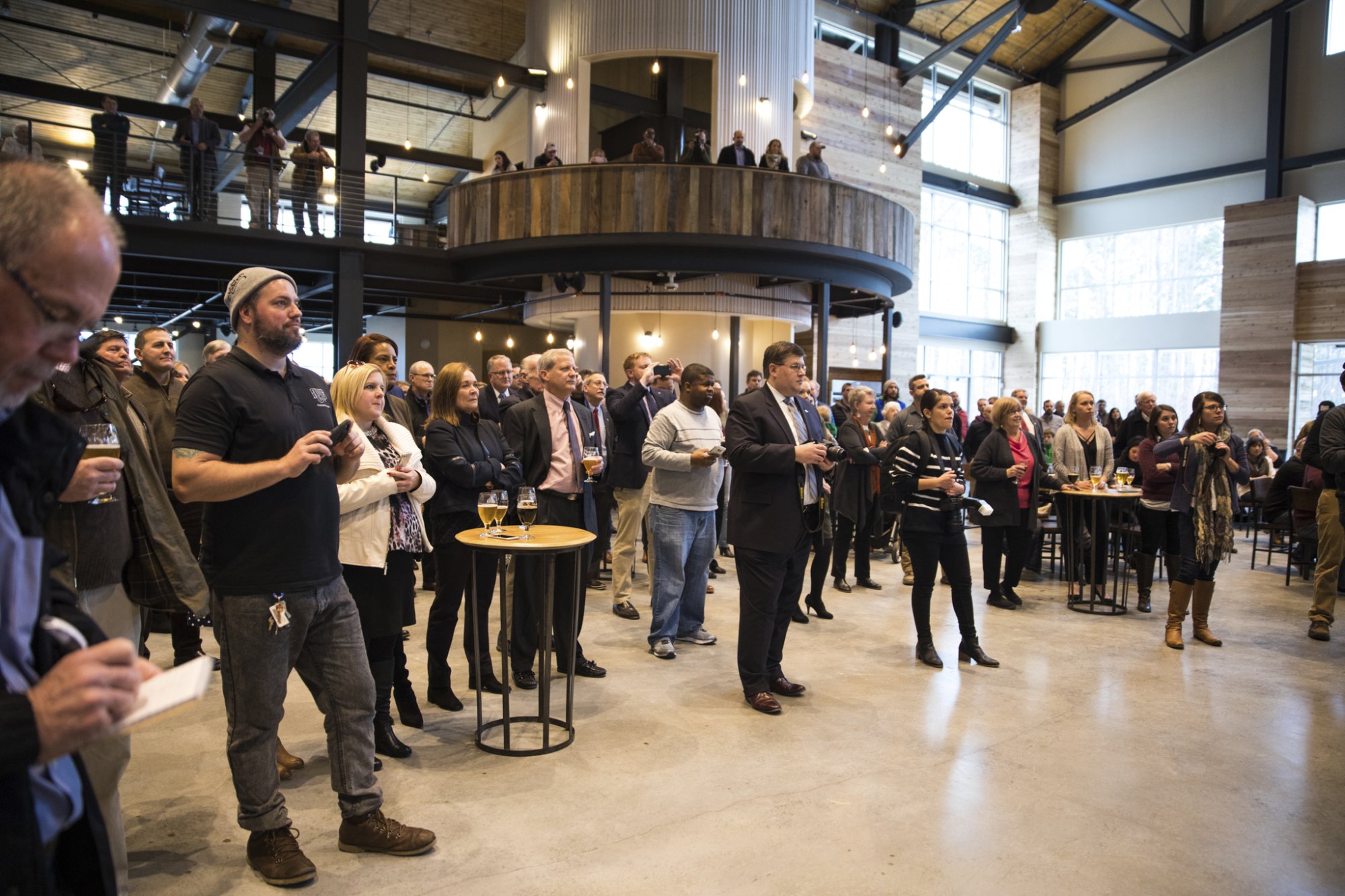
GOOCHLAND, Va. — There are a lot of numbers behind the new West Creek Hardywood Park Craft Brewery — a 60-barrel brewing system in a 55,000-square-foot brewery with a 4,000-square-foot taproom on 24 acres in Goochland — but one of the most significant may be 28, the number of breweries established since the first Hardywood opened in 2011. At the time there were only three other local breweries; barely six years later there are 32 total, and that’s not counting local cideries.
On Monday, Jan. 8, Gov. Terry McAuliffe joined Hardywood co-founders Eric McKay and Patrick Murtaugh in a ribbon-cutting ceremony; the last one on the schedule as governor for staunch craft beer advocate McAuliffe.
McAuliffe was there in November 2015 for the ground breaking ceremony of the $28 million dollar project, which will add 60 jobs and triple their current output on Ownby Lane, starting first with 35,000 barrels of annual brewing capacity.
Though McAuliffe did not sign SB 604, which gave breweries the ability to sell beer for on-premise consumption without having a full-service restaurant, he has been a champion for the agriculture benefits of the resulting craft beer boom.
Hardywood, who helped lobby for SB 604, said that their commitment to incorporate local grains, hops, fruit and other products in their beer has made them the largest purchaser of Virginia agricultural products in the brewing industry. For example, Murtaugh said 20 pounds of Casselmonte ginger was used in the first batch of acclaimed gingerbread stout; the last batch required 1,000 pounds of the Powhatan-grown rhizome.
The new Hardywood Brewery is a 55,000-square-foot brewery with a 4,000-square-foot taproom on 24 acres in Goochland Photo by Kate Magee
Several years ago, Hardywood hired Kate Lee, a 12-year veteran of Anheuser-Busch, to oversee the quality assurance program, offering her experience as Hardywood increases production at the new West Creek site. Pedigreed brewers from New York, California and Oregon have joined the team of 60 employees.
The 60-barrel BrauKon brewhouse will initially be dedicated to brewing flagship beers Singel, Pils and VIPA, and its Virginia Roots series of beers brewed with Virginia ingredients.
The facility will include a public taproom, mezzanine, conference room, outdoor patio and beer garden, food truck plaza,bocce courts and a natural amphitheater for live performances. The taproom offers views of the brewing process, including the brewhouse, fermentation hall, quality assurance lab, ingredient processing area and packaging warehouse.
A soft opening is planned for February 2018 and the grand opening of the brewery will be April 6-8, 2018.
Hardywood joins three other Goochland breweries: Lickinghole Creek Craft Brewery, Midnight Brewery and Kindred Spirit.
Comments Off on Grand opening date set at Hardywood Park Craft Brewery: West Creek
WASHINGTON, D.C. — We stood closely, hushed by the formality of the moment while Secret Service stood nearby, lazily watching us and flanking the doorway that led to another section of the White House.
In two minutes the door to the library would swing open and we would step inside for an interview that few will ever have in their career. I noticed we were both taking deep, calming breaths.
It had been just 24 hours ago since my boss told me I would be sent to Washington D.C. to assist the photographer and reporter interviewing President Obama from the White House.
My boss Scott Wise responded casually to an email thread about a potential story.
“Also–I’d like to send you to the White House tomorrow with Tracy Sears to cover her interview the president,†he wrote to me at 11:12 a.m. Tuesday.
“So that’s not the email I expected to get back from you,†I responded. “Surprise,†he replied.
I work the 3 p.m. to midnight shift and was told simply to bring a bag into work and leave from there.
The whole affair began rather innocuously with a phone call from a man who wished to speak with reporter Tracy Sears, employed at WTVR, a CBS affiliate in Richmond, for almost 13 years.
Of course he was met with skepticism when he identified himself as the Deputy Press Secretary of the White House, Eric Schultz.
“Is this my husband?†Tracy asked, convinced it was him or a mutual friend trying to “punk†her.
He laughed and assured her that wasn’t the case. Still in disbelief she asked for him to send an email, seconds later it arrived and boasted the right string of identifying credentials: who.eop.gov.
That’s when things accelerated.
If television isn’t your industry, you may have a hard time imagining the preparation that began to occur. What you see on the television screen, hopefully, is a well-coiffed reporter, framed and nicely lit. Now, getting the reporter zapped live to your television from a remote location isn’t as effortless as it looks by the time you see it.
You don’t see the sweat from lugging gear around–cameras, microphones, lights, tripods–or the scurrying around to make deadline against all the odds.
You don’t see a producer, or someone from the news desk or master control (staffed 24-hours a day, the final point before a signal is transmitted over-the-air for broadcast television) freaking out because heavy rain can interfere with the microwave truck broadcasting the photographer’s live shot, which means the reporter might not make “slot†in the newscast–if at all.
Many in the newsroom didn’t even know about the interview until the day it aired. We were sworn to secrecy until the 5 p.m. newscast Tuesday, less than 24-hours from when Tracy’s interview would happen.
Though a bold task, one of our first decisions was to engage our Facebook fans in this one-on-one presidential interview.
STATE OF THE NATION
Pew Research polling shows that 61% of Americans sampled are following along with the shutdown discussions and only 22% aren’t concerned about its impact.Â
More Americans disapprove than approve of the way that all sides – Barack Obama, Democratic leaders and Republican leaders – are handling the negotiations over the shutdown, according to the polling data.
Though on our station’s Facebook page, if that’s any type of sample, the blame is most often directed towards the president. Regardless of the subject, or the factual information, the vitriol is posted in spades.
We promoted the one-on-one with the hashtag #AskObama, researched the questions and people who proposed them. Eventually we decided on two questions we would ask President Obama. The entire thread is here:
ASK OBAMA: President Barack Obama will answer questions posed by Tracy Sears – WTVR CBS 6 Wednesday afternoon. DETAILS…
In total, four East Coast stations were chosen to sit down with the president; Tampa, Fl., Philadelphia, Pa., Washington DC and CBS 6. No one has explained, despite inquiry, the process of selecting these four stations and reporters.
Virginia, with a large concentration of federal employees, contractors and veterans, definitely feels the pinch of an ongoing federal shutdown that began initially with Republicans wanting to defund the health-care law, and it would only get worse in an economic shutdown.
WHOSE AGENDA?
Certainly no one turns down an interview with the president, the esteemed leader of our nation, and a man respected around the world. A good reporter knows what balance to strike, what questions to ask.
Other journalists say that despite the “mutual loathing pact†between Obama and the D.C. press corps, Obama in his first term gave three times the amount of interviews–TV, radio, Internet, print– that George W. Bush did, (647 versus 217) and for William Clinton (191) it was even less.
But Obama has a different strategy than other presidents. By contrast, Bush held 354 short question-and-answer sessions with reporters compared to Obama’s 107 sessions, according to statistics compiled by Matha Kumar.Â
With such strategy the president has more control over timing with the one-on-one, less impromptu interviews and there are fewer opportunities for follow-up questions. But he’s also providing incredible opportunities for local stations to relate national and world news directly to their market.
Regardless, we were going and we were excited. Two a.m. found me sleepless with a pillow over my head to black out the fluorescent lighting shining into the hotel room two miles away from Capitol Hill.
FAIR AND BALANCED
Wednesday would remain mostly as grey and monochromatic as the stone and marble of the secured D.C. buildings which we stepped in and out of, so it was only an alleged sunrise that followed our car towards Capitol Hill that morning.
Hulky security guards loomed, sentinels more visible than tourists under the shadow of a government shutdown which also accounted for the absence of many employees.
Their profiles along the steps and perimeter ominously recalled recent violence: Navy Yard shooter Aaron Alexis, rogue driver Miriam Carey, and then 64-year-old John Constantino who died from self-immolation on the National Mall.
Having visited the area my entire life, this new District of Calamity feels different, less accessible to its public owners. Since 9/11 our nation’s capital has been fortified through incremental steps, including the closure of streets and jersey barrier construction, all designed to shield sensitive buildings.  The access that has become complicated for many is more easily granted when you are on the list, as our names were, at the first stop to interview House Majority Leader Eric Cantor at his Capitol office.
Still, our access wasn’t without its rules. We had to throw out our bottles of water as we went through security; yes, the security guard said, even if mine was sealed.
Cantor’s interview was five hours before Tracy would meet with President Obama, providing a balance of sorts by questioning two polarizing men within the government.
The political divide in our nation shows no more clearly than at this time of great strain, when it’s easy to feel that questions and answers are so often anchored in partisanship and not solution. The entire transcript of Tracy’s interview with Cantor can be read here.Â
ROAD TO THE WHITE HOUSE
When you’re reporting from the road you wind up in a lot of MacGyver situations.  At one point in the day I remember seeing Tracy with her curling iron plugged into an available outlet, located beside a water fountain in the White House press briefing room.
We weren’t expected at the White House for another hour after Cantor’s interview, so we set up shop in a paid parking space and Tim Hawkins, our chief photographer, had to “feed†video back to the station. We use something called a Teradek that can stream video over an internet or cellular connection, which is recorded into the main system as it streams back.
At one point I looked back and saw his square black case open, with various transmitters and wires peeping through, and then quickly wrenched my neck around in all directions to see if anyone looked alarmed. After all, we just had to throw away sealed bottles of water to get into a building.
I noted several black SUVs parked around us, and men with IFBS standing around on the sidewalk, but it was D.C. after all and that’s a pretty common uniform these days. No one had tackled Tim or seemed to consider the case a suspicious package.
Tim packed up gear once again and we headed towards 1600 Pennsylvania Avenue.
One might think that security at the White House would be most daunting but the guys there are pretty nice; maybe because somewhere behind the office where we checked in sits a team of snipers and savvy bodyguards.
A separate team would stage and record the interview with the president, but we still had heaps of equipment to bring for evening news live shots, which would boast in the background that classic north lawn view of the White House that is usually reserved for the network stations.
White House security went through all equipment we had, including my laptop and iPad, checking for bugs and explosives. We were given our press badges, which are swiped over a keypad that then green lights us to walk through the second checkpoint–a metal detector and x-ray machine for our phones and miscellaneous things.
And suddenly we were on the other side of the gate, looking back at the tourists.  We walked toward the West Wing, into the theater converted from Theodore Roosevelt’s swimming pool into a press pool.
The space felt like a combination of an airplane and a bunker or ship galley. The blue, first-class leather seats allegedly cost around $1,500 in the renovation. Each seat, 49 in all, is assigned to a news organization, and behind the rows of seats stretches a long expanse of granite top that houses below little cubbies. A power outlet under the seat was a desperate oasis of electricity for my needy iPhone 5 battery.
It could have easily felt suffocating, yet the constant flutter of activity seemed to arrange space frequently enough to keep it from being claustrophobic. Slender hallways with cramped off-shoots house different news organizations. Presumably there are more offices downstairs, though I didn’t see any, just noticed a steady flow of back and forth traffic.
Tracy and other reporters let to meet Dennis McDonough, the White House Chief of Staff, to be briefed for the upcoming interview. It was 12:30 p.m. and Jay Carney was expected to enter the pressroom shortly for an afternoon briefing.
It was around 1 p.m. when he did enter, though we had all just reached the point of awareness that in about an hour Tracy would be interviewing the president, and it was hard to focus on much else. Tracy was going over her notes and I took notes on the press conference.
Despite the number of times that Carney said “ransom†in reference to the Republican Party taking the government hostage in attempts to defund the ACA, the press briefing was probably one of my favorite parts of the day. I discovered on my way to the bathroom that a loudspeaker broadcasts the briefing through the entire press cave.
The Press Secretary addressed one of the viewer questions that we planned to ask President Obama, about the payment of death benefits to the families of military, which had lapsed with the government shutdown. On Friday, legislation was passed to resume benefits.
HELLO MR. PRESIDENT
A man came by and grouped all the visiting news stations together to lead us into the White House. We walked downstairs, outside and past a covered BBQ grill, and then into the White House, ground level.
A long hallway stretched out in front of us. The plush red carpet that blanketed the white marble floor muffled our footsteps while low vault ceilings shaped the way past rooms full of security, down to the Vermeil room where we would wait.
The interview was directly across the hallway, in the room that Franklin D. Roosevelt converted into a library in 1961.
We were ushered into the Vermeil room and warned not to sit on the actual furniture, but rather use the chairs provided for us. We were reminded no picture taking, nor eating or drinking in the facility either. I believe each suggestion was overlooked by some, if not all of us.
Vermeil is a combination of sterling silver, gold, and other precious metals, commonly used as a component in jewelry. Shiny, centuries-old pieces adorned the shelves.  Several First Lady portraits hung in the room; Jacqueline Kennedy, Eleanor Roosevelt, Lou Hoover, Patricia Nixon, and over the mantle Claudia “Lady Bird†Johnson.
If you’ve never seen the White House, Google has mapped the entire mansion as part of their arts project. You can click here to see it.
The door opened and we were beckoned to the hallway to wait with White House staff and Secret Service.
Despite the money and time our station spent on this interview, we had very little contact with the president. As it was, he was seated when we walked in, with a chair across from him set up for Tracy. It would have been ideal for him to stop and say hello to the entire group, take 5-10 minutes to do that simple thing before the interview.
Each reporter, plus one producer, was allowed in the room with the president. An iPad and an iPhone tightly controlled time with a running stopwatch. We had been told that all details from our interview were to remain secret until 5 p.m., though no reason was given why. For an administration so reliant on social media, it was surprising we couldn’t use it to communicate or promote the interview.
One crew lit and filmed all interviews and we were warned to take no pictures, a house photographer would take a two-shot of reporter and president.
Eight minutes with one the most powerful men in America goes quickly, it’s about the length of a shower. Tracy’s interview stopped at nine minutes and forty seconds.
At the end, the President offered to write two cards for each of her children, after she asked a question on behalf of her son’s third grade class.
As an interactive web producer, I was frantic to get a photo of the moment. The cameras weren’t rolling and the staff photographer wasn’t shooting. I asked if he would shoot the picture, and he said he already had one.
My phone was in my hand and I know I was just wide-eyed in panic that the moment wouldn’t be captured. Thankfully, a staffer leaned in and whispered calmly that it was just fine if I want to snap the shot. Now we’re talking! I wish I had tried this tactic at the beginning.
This left me with one photo document of the one day I was five feet away from the president. It’s not even a great photo, due to the stiff angle I had to work with.
And that was that. We waited for the others and then returned to the press room to get ready for Tracy’s live shots on the 5 and 6 p.m. newscasts, and then we headed home to get ready for the 11 p.m. show. By the time I left work, it had been an 18-hour day.
The last picture I took inside the gate was of my press pass. I couldn’t help but think on my way out, as I begrudgingly surrendered the PRESS badge, about the double duty the word serves.
In America, a member of the free press–an actual novelty on a global stage–is given that chance “to bear down on, to force to action, to squeeze contents from, to lay stress on–to emphasize.â€
And no matter which side of the White House gate–or the political line–that you’re on, it’s clear we must press forward from these trying times with the right amount of strength and grace.
The press must diligently push for its own right to access if we are to best serve our readers.
In Richmond’s East End, six housing projects huddle around the Peter Paul Development Center. Then, I-64 wraps around the entire area, successfully positioned as a moat, or wall, which isolates the concentrated urban poverty from the resources of greater Richmond.
In this bleak city island, Â poor means an average income of $8,900, says Rev. Lynne Washington, executive director of the Peter Paul Development Center (PPDC).
Rev. Washington is our guide on the Windshield Tour, which safely carries us into areas of town many will never visit; to witness landscapes many of us would never forget were we to see them.
The Windshield Tour is about a 90 minute event. Aboard the bus, participants learn interesting and shocking facts about the neighborhoods served by the PPDC.
For example, no new schools have been built in this neighborhood–even though there are 4,000 children in Churchill–since the 1950’s, says Rev. Washington.
Or that “ Newsweek†magazine considers Armstrong High one of the nation’s worst “drop-out factories.â€
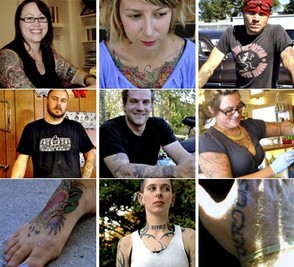
It flatters the walls of numerous galleries, ornaments our streets and buildings and also adorns the skin of many locals.
They don’t all work in downtown restaurants and bars either, although tattooed culinarians and mixologists might be seen more often. No, tattooed folk don’t all band together like a heathen zombie army.
Actually they’re everywhere, just not always visibly. They also teach children, save lives, prepare fancy pumpkin spice lattes, labor at state agencies, report the gritty city news, fashion your hair, hawk real estate, mark Richmond criminals and ink grants. Many have infiltrated well-known, Fortune 500 corporations.
Please follow the link to read the rest of this article and view a great slideshow on Richmonddotcom! Thanks!
The visions of 13 people—what you missed and how you can be involved in the city’s new transit plan.
Richmond Connects, a City of Richmond project, staged its kick-off event Tuesday night at the Byrd Theater. Participants were asked to present alternative visions of transportation in an alternative format: 20 slides, 20 seconds a slide.
This trendy and effective method known as “Pecha Kucha” is loved by the Japanese and seems to abate long-winded, awkward presentations.
The format itself was a breath of fresh air, as were many of the ideas presented.
The evening moved along like a well-oiled machine, hopefully one with a small carbon footprint, but whether or not the talks are just a bunch of hot-air remains to be seen.
The City of Richmond, with its recent creation of a Bicycle and Pedestrian Trail Commission, as well as proposed funding in the 2012 budget for a Bicycle and Pedestrian Coordinator, appears committed to reducing the number of vehicles on the road. Money has been pledged to develop the plan, but more than that half a million will be needed to complete any infrastructure (Portland, Oregon spent an estimated 52 million).
At the very least, Tuesday nights’ presenters made it clear that the city ought to take transportation reform very seriously.
SPOKEN QUICKLY, DRIVEN HOME
Some clambered on stage to speak their 6:40 (20×20) as concerned residents, bringing out-of-state experiences to the envisioning process.
Numerous restaurants in Richmond are violating, some without knowing, some simply disregarding, what many see as an invasive prohibition on social media promotion.
Gone are the days of Speakeasies, Prohibition-era liquor establishments, where liquor discreetly flowed for those whose tongues were agile with the correct password for entry. Even though billions of dollars now steadily pour into the coffers of alcohol manufacturers, in Virginia restaurants dare not speak easy about happy hour pricing.
Not too long ago restaurants were completely prohibited from promoting happy hour outside of the storefront. In late 2009, the ABC board approved the posting of a 17″ by 22″ sign in the window of a restaurant. This action symbolized forward movement from an organization often thought of as conservative.
When but not What
The momentous change spawned signage in windows, announcing, yes the business has a happy hour–a fact probably already known by 10 of 10 adults. In an urban setting, the sign might make a difference, but in a suburban setting, most restaurants receive specific destination traffic.
What really matters to those seeking the heaviest drinks for recession-light wallets are the prices, the choices, and the times. Times are actually allowed on the posted sign, but no specific mention of available selections, or the special prices is permitted.
“What the customer is deprived of is the information about what kind of specials are being offered,” said Thomas Lisk, an attorney at Eckert Seamans who previously served as chairman of the Industry Advisory Panel to the Virginia ABC Board during its regulatory review process.
Back when I was a fiscally struggling undergrad (my, how things don’t change), I took a series of lab-rat gigs at VCU. The money wasn’t great, but it paid out right away and I didn’t have to donate anything other than my time, patience and a little blood. The studies were only for tobacco research and required that I be a smoker. This is a preface to the bigger story, the current one of my becoming a non-smoker.
One of the gigs required that I stay overnight, go without coffee two days prior and no cigarettes were allowed 12 hours prior to check-in at MCV hospital.
Once settled in, I was given a series of hourly tests that involved my cognitive reflexes and memory retention. I found it rather interesting that they wanted to know how my brain worked without tobacco.
I interrogated the doctors and researchers about tobacco and the brain to learn just why nicotine is so addictive. Here’s what I’ve learned and why it is so hard for many of us to just quit cold turkey.
Simple science behind addiction
There is a perception out there that tobacco is merely a physical addiction. See, the tricky thing is that your brain is a tangible, physical part of you, but there are also many complex, mysterious things happening inside it that we can’t see. Science has made huge leaps in explaining some of it. Point being, they’re connected—mind and body. Withdrawal isn’t simply about nicotine decreasing in the bloodstream (physical), it is also about the way your neurotransmitters are firing messages (mind).
A smoker is going through nicotine withdrawal the minute they put out a cigarette. Let’s be science-like and call it pain conditioning. Pain conditioning (and pleasure conditioning) involves neurotransmitters that reinforce the neural pathways which develop with newly learned behaviors.
Think of a neurotransmitter as “an automobile wearing ruts in a gravel road.”
This applies to all types of behavior and learning—from avoiding touching a hot iron to associating an “A” on a test with a reward. I could go on with the examples but, basically, that “deep neural rut” in your neural pathway is what makes a reaction become automatic.
For smokers, the reactions are provoked by times, meals, activities and emotions.
To learn more about the science of addiction and the success rate of Chantix, please jump over to Richmond.com to finish reading!
Comments Off on Medicine helps snuff out smoking habit